
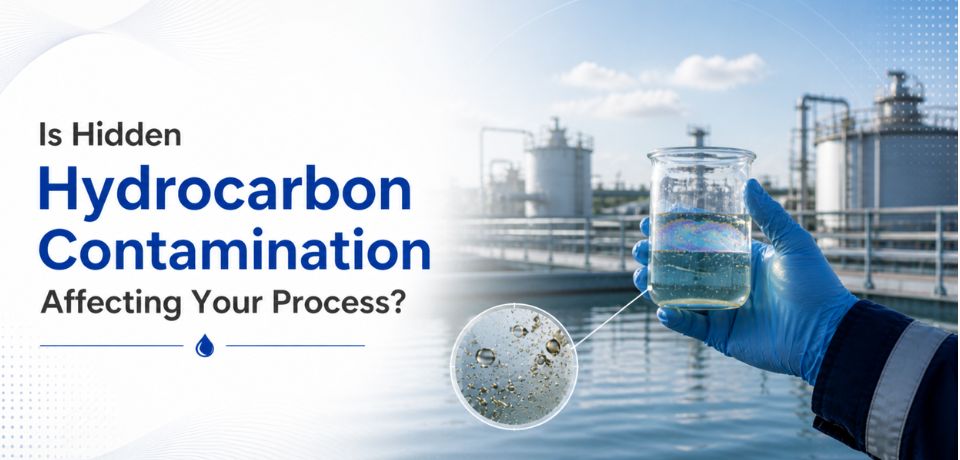
Oil contamination in water is a significant operational concern across industries such as power generation, refining, manufacturing, and wastewater treatment. Even small amounts of hydrocarbons can reduce heat-transfer efficiency, disrupt downstream processes, and lead to regulatory non-compliance.
Relying on manual grab sampling or outdated detection methods often results in delayed identification, missed transient spikes, and inconsistent data—leaving facilities vulnerable to both operational and environmental risks.
This blog explores the key challenges in accurate oil-in-water monitoring and why real-time, continuous measurement has become essential for modern process reliability.
Common Challenges in Oil in Water Monitoring
1. Delay in Detection
Traditional grab sampling and lab analysis take significant time to process, meaning operators often discover oil contamination only after it has already spread. This delay can lead to:
- Increased environmental discharge
- Equipment fouling and corrosion
- Higher maintenance costsReal-time monitoring is essential to avoid these consequences.
2. Inaccurate or Interfered Readings
Water turbidity, suspended solids, and variations in temperature frequently interfere with basic optical or absorption-based instruments. This results in unreliable oil-in-water measurements and unclear data for decision-making.
3. Inconsistent Monitoring
Periodic sampling fails to capture sudden pollution events or intermittent oil leaks. Without continuous monitoring, facilities risk missing critical contamination events, often leading to regulatory non-compliance and process inefficiencies.
Case Scenario: Unexpected Oil Leak in Cooling Water System
A power plant was experiencing recurring alarm trips and unexplained increases in cooling water TSS/organics—but traditional sampling wasn’t providing timely insight. By the time lab results were available, units had already been compromised, leading to costly shutdowns and maintenance interventions.
The solution was to implement continuous online oil-in-water monitoring systems that could detect oil contaminants as soon as they entered the water stream—providing operators with actionable data and immediate alerts.
How Benchmark Solutions TD-120 & TD-560 Resolve These Challenges
TD-120 Oil in Water Monitor
The TD-120 uses advanced UV fluorescence technology for highly sensitive and reliable oil detection. It is designed to resist interference from dirty or turbid water while offering a broad dynamic range up to 6000 ppm. FEATURES include:
- Sensitive detection of hydrocarbons, fuels, lubricating oils, heat transfer fluids, and crude oil at low ppm/ppb levels
- Minimal maintenance with no need for reagents or instrument air
- Internal tablet interface for quick setup, calibration, and operation
- Built-in data logging and diagnostic display for historical analysis
- Auto-valve capabilities including temperature protection and fresh water flushThis makes the TD-120 ideal for detecting oil leaks from heat exchangers, protecting boilers, water intakes, and membrane systems while optimizing overall water treatment performance. Benchmark Measurement Solutions
TD-560 Oil in Water Analyzer
The TD-560 goes a step further with dual-channel detection, enabling monitoring of both heavier hydrocarbons and lighter hydrocarbons such as BTEX, gas condensates, gasoline, jet fuel, kerosene, transformer oils, styrene, and phenol. Capable of detecting in ranges from low ppb up to 5000 ppm, it features:
- Large full-color touch screen for intuitive operation
- Advanced data logging, analysis, and graphing
- Compatibility with popular extraction solvents and Benchmark’s No-Solvent Method
- Correlation of results to official lab methods like USEPA 1664A and ISO 9377-1The TD-560 is particularly useful for monitoring produced water, wastewater, discharge compliance, stormwater, and treatment verification. Benchmark Measurement Solutions
Benefits of Real-Time Oil in Water Monitoring
With online monitoring systems like the TD-120 and TD-560 in place, facilities gain:
✔ Continuous, real-time visibility into oil contamination✔ Immediate alerts when oil levels exceed thresholds✔ Reduced reliance on manual sampling and lab turnaround times✔ Better protection for mechanical systems and membranes✔ Easier regulatory compliance and reporting✔ Lower operational risks and maintenance costs
Instead of reacting to contamination events, operations teams can now proactively manage water quality.
Conclusion: Reliable Monitoring Means Better Outcomes
Oil in water contamination can cripple industrial operations, damage critical equipment, and lead to costly regulatory issues. The right monitoring strategy—powered by advanced analyzers like the Benchmark Solutions TD-120 and TD-560—provides accurate, continuous insights that empower faster decisions and safer operations.
Whether you are dealing with cooling water systems, wastewater discharge, intake protection, or produced water streams, these instruments give you the visibility and confidence you need to keep your processes running smoothly.
Talk to our engineers
Need help applying this to your plant? Our team will help you choose and size the right analyzer.
Request a Consultation